
If you’re confused about fastpitch softball pitching distances, you’re not alone.
Parents, new coaches, and even players often ask the same question:
“How far should a pitcher throw at each age?”
Let’s clear it up quickly and simply.
Quick Answers
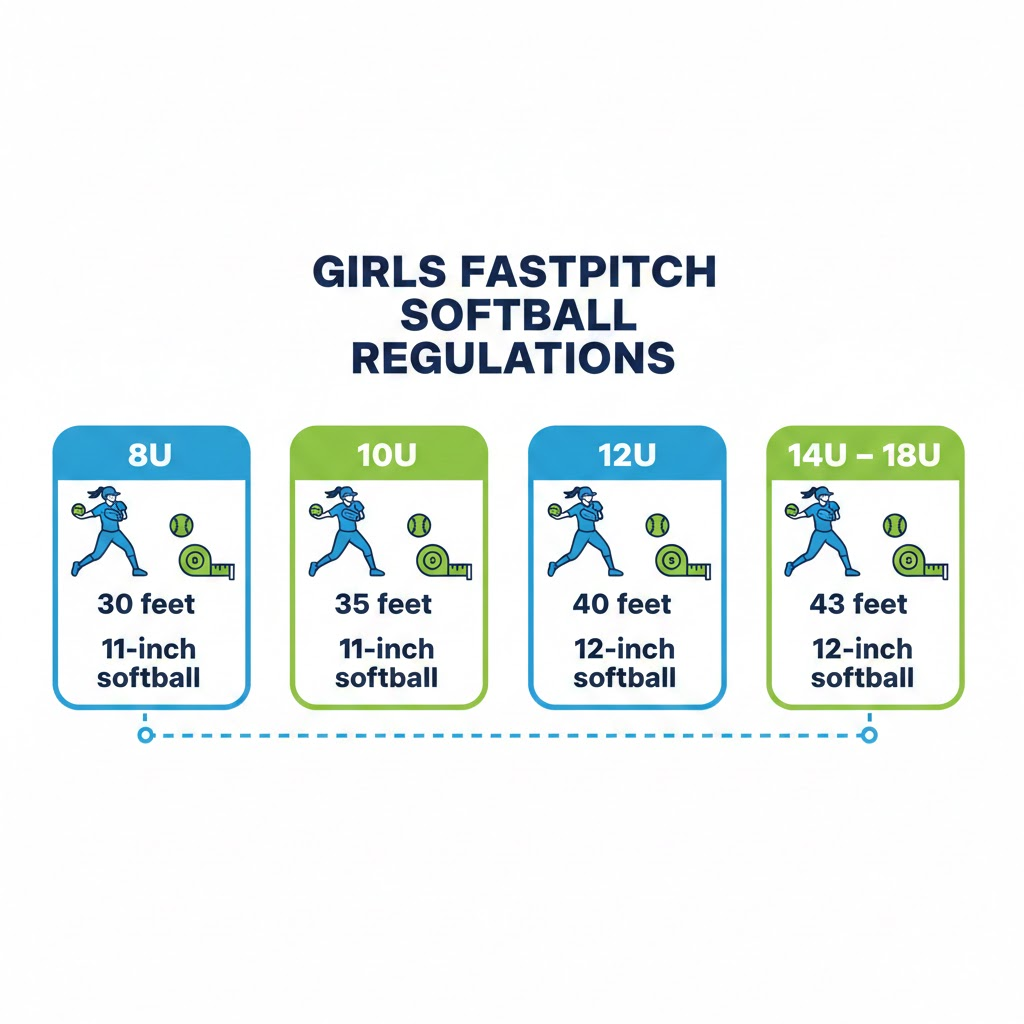
Here are the official fastpitch softball pitching distances most leagues use:
- 8U: 30 feet | 11-inch softball
- 10U: 35 feet | 11-inch softball
- 12U: 40 feet | 12-inch softball
- 14U – 18U: 43 feet | 12-inch softball
Short version:
Pitching distance increases as players grow stronger, faster, and more skilled. The most challenging transition usually happens between 12U and 14U.
If this already answers your question, you’re good.
If you want to understand why these distances matter—and how to help a pitcher adjust smoothly—keep reading.
Why Pitching Distance Matters More Than You Think
Pitching distance isn’t just a random rule—it directly affects:
- Reaction time for pitchers
- Pitch speed and control
- Injury risk
- Fairness and safety in the game
As players grow, leagues increase the distance to keep the game competitive without putting pitchers at risk. Too short becomes unsafe. Too long becomes frustrating.
Fastpitch Softball Pitching Distance by Age (Explained Simply)
8U Pitching Distance – 30 Feet
At the 8U level, pitching is about learning, not dominating.
Most pitchers are:
- Getting comfortable on the mound
- Learning basic mechanics
- Building confidence
Accuracy matters more than speed here. If a pitcher can throw strikes consistently at 30 feet, that’s success.
10U Pitching Distance – 35 Feet
At 10U, things start to level up a bit.
The move to 35 feet:
- Challenges control
- Introduces better wrist snap
- Tempts pitchers to overthrow
A very common mistake at this stage is trying to throw harder instead of throwing smarter. If accuracy dips at first, that’s completely normal.
12U Pitching Distance – 40 Feet (The Big Transition)
This is the make-or-break stage for many pitchers.
Why 12U feels so hard:
- Distance increases
- Ball size increases (11″ → 12″)
- Bodies are changing fast
- Confidence can drop suddenly
Many pitchers feel like they’ve “lost it.” They haven’t. They’re just adjusting.
A smart approach is to occasionally practice from 43 feet before moving up officially. That small exposure makes a big difference later.
14U, 16U & 18U Pitching Distance – 43 Feet
At 43 feet, pitching becomes a balance of:
- Speed and control
- Strength and mechanics
- Confidence and patience
This is where strong leg drive, core stability, and clean mechanics matter far more than raw arm strength.
Why Pitching Distance Increases With Age
Pitching distance changes because:
- Players get stronger and faster
- Batters react quicker
- Safety becomes more important
- The game becomes more competitive
It’s not about making things harder—it’s about keeping the game fair and safe.
Softball Size Changes (And Why It Feels Weird)
The jump from an 11-inch to a 12-inch softball can feel awkward at first.
The bigger ball:
- Changes grip
- Adds weight
- Improves spin potential
Once pitchers adjust, many actually gain better movement and control.
Common Problems When Distance Increases
If you’ve noticed any of these, you’re not alone:
- Loss of accuracy
- Slower pitch speed
- Arm fatigue
- Frustration or self-doubt
These struggles are normal during transitions—not signs of failure.
How to Transition Smoothly (What Actually Helps)
The best transitions happen when:
- Distance increases gradually in practice
- Focus stays on mechanics, not speed
- Legs and core do the heavy lifting
- Pitchers don’t rush the process
Patience now prevents burnout later.
Simple Drills That Really Work
You don’t need complicated drills to improve.
Some effective ones:
- Walk-through drills to build power
- Progressive long toss to get comfortable with distance
- Wrist snap drills for control and spin
Consistency beats complexity every time.
Safety & Injury Prevention (Very Important)
Watch closely for:
- Shoulder or elbow pain
- Sudden loss of control
- Fatigue that doesn’t go away
Rest is part of training. Overuse helps no one.
Final Thoughts
Pitching distance isn’t just about feet—it’s about growth.
Every pitcher struggles at some stage. The ones who succeed aren’t the ones who rush, but the ones who develop patiently and confidently.
If there’s one thing to remember:
Progress always beats perfection.